
An order lands in the inbox. Someone opens the PDF, checks the ERP, messages the warehouse, updates a spreadsheet, and follows up tomorrow. The company has software for every department. The workflow still runs on somebody remembering the next step.
That is where agentic AI can earn its place: in the research, interpretation, and follow-through between systems. The opportunity is to give a defined piece of work the ability to move forward, while your team stays accountable for the outcome.
How do you move from traditional ops to agentic AI ops?
Start with one measurable workflow. Map its decisions and exceptions, connect the authoritative data, and give an AI agent a narrow job with limited tools. Test it without taking action, introduce human approvals, then allow selected low-risk actions after it meets your quality targets. Expand based on verified results.
What is agentic AI ops?
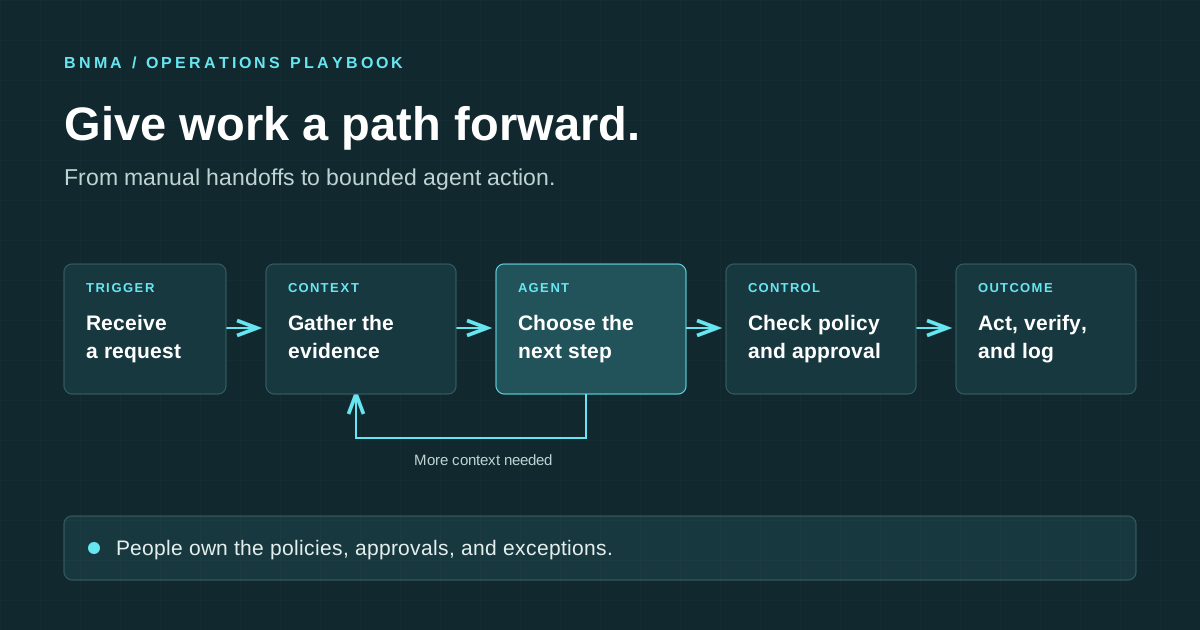
Agentic AI operations is an operating approach in which AI agents interpret incoming work, choose next steps, and use approved tools to advance a business process within defined limits. People own the policies, approve consequential decisions, and handle exceptions the system cannot resolve.
A conventional automation follows a predetermined sequence. An agent can choose which information to retrieve or which permitted step to take based on what it finds. Anthropic makes this architectural distinction in its guide to building effective agents.
For example, an order agent might check whether a request is a duplicate, look up missing product details, investigate a stock shortage, and prepare a resolution. Which steps it needs depends on the order. A simple document extractor following a fixed sequence can be useful without needing that autonomy.
A note on terminology: AIOps usually means artificial intelligence for IT operations, including monitoring and incident analysis. This guide uses “agentic AI ops” more broadly for business operations, with IT as one example. “AgentOps” can also refer to the tooling used to monitor and manage AI agents themselves.
What actually changes in the workflow?
Traditional operations depend on people to interpret requests and coordinate handoffs. Rules-based automation handles repeatable steps. Agentic operations add a component that can investigate a situation and choose among permitted actions. All three can coexist in the same process.
| Work to be done | Traditional ops | Fixed automation / RPA | Agentic AI ops |
|---|---|---|---|
| Understand a request | A person reads and interprets it. | Rules process expected fields and formats. | AI interprets the request and gathers relevant context. |
| Choose the next step | A person decides who or what comes next. | A predefined branch determines the action. | An agent selects a permitted step based on evidence. |
| Handle an exception | Someone investigates across systems. | A known rule handles it, or the workflow stops. | The agent investigates within its scope or escalates with context. |
| Complete the work | A person updates records and follows up. | Code executes a specified transaction. | Approved tools execute actions; checks verify the result. |
| Own the outcome | A named process owner. | A named process owner. | A named process owner. |
The last row matters. An agent can receive permission to act. Accountability stays with the business.
Which workflow should you move first?
Choose recurring work with accessible data, a clear owner, a result you can verify, and manageable consequences if something goes wrong. Look for work where people spend more time gathering context than making the final decision.
Order exceptions, support triage, and assembling project information are useful candidates to investigate. Interview the people doing the work and follow several actual requests from arrival to completion. Include the awkward cases everyone has learned to work around.
- Volume: Does this happen often enough for improvement to matter?
- Interpretation: Does the work require reading varied documents or investigating changing circumstances?
- Access: Can the system retrieve the necessary records with appropriate permissions?
- Verification: Can you prove that the right thing happened?
- Recovery: Can someone stop, correct, or take over the process?
If the task is simply moving a known field between systems, an integration may be enough. If one model call can classify a message for a fixed workflow, start there. Our guide to choosing between an AI agent and traditional software goes deeper into that decision.
Write a one-sentence scope before building: “For incoming order requests from existing customers, prepare a validated draft order or an exception packet for the order desk.” That gives your team something concrete to design, test, and own.
Four examples of traditional ops becoming agentic AI ops
These are illustrative workflow designs, not reported BNMA client results. Each example separates what the agent can do from decisions that require human approval.
01 / Distribution and order management
Turn a messy purchase order into a decision-ready draft
Today: An employee reads an emailed purchase order, retypes line items, checks pricing and availability, and chases missing details.
With an agent: The system extracts the request, matches customer and product records, checks for duplicates, and investigates discrepancies using approved ERP tools. Code validates quantities, prices, and totals before a draft order reaches the reviewer.
A concrete exception: The customer requests 100 units; the current inventory record shows 60 available. The agent prepares options for a partial shipment or a backorder, cites the availability timestamp, and drafts a clarification. It cannot invent a delivery date. If inventory changes before approval, availability must be checked again.
The boundary: Product substitutions, price overrides, credit decisions, and delivery commitments go to an authorized employee. The initial pilot creates drafts only.
Measure: Time to a validated draft, correction rate, and duplicate orders prevented.
02 / Construction operations
Move a field issue toward an informed response
Today: A project coordinator searches emails, drawings, daily reports, and project records to assemble the background for a request for information (RFI).
With an agent: An incoming field report triggers a search of the permitted project records. The agent finds relevant document revisions, links the supporting material, identifies missing information, and drafts an RFI for the project manager.
A concrete exception: The report refers to an opening that differs from a drawing. The agent finds conflicting revisions and flags the conflict with source links. It asks the responsible person to identify the controlling document before the draft proceeds.
The boundary: The agent cannot approve a design change, interpret site safety requirements as an authority, or authorize additional cost. The project team reviews and issues the RFI.
Measure: Time to assemble the RFI packet, missing-source rate, and reviewer rework. Reliable construction software integration makes this possible.
03 / Customer support
Investigate a customer issue before the handoff
Today: A support rep reads the ticket, verifies the customer, checks order history, consults the policy, and routes the issue.
With an agent: After identity and access checks, the agent retrieves the relevant records, identifies what still needs investigating, and prepares a sourced response. It can classify the case and route it to the right queue under explicit rules.
A concrete exception: A customer reports a missing delivery. Tracking says “delivered,” but the order contains two packages. The agent checks both shipment records and prepares a response that distinguishes their status. Conflicting evidence goes to a person with the investigation attached.
The boundary: Refunds, account changes, and compensation require the defined approval path. Retrieved messages cannot grant the agent new permissions.
Measure: Verified resolution rate, reopen rate, and customer effort alongside response time.
04 / IT operations
Give the on-call engineer a useful investigation
Today: An engineer switches between monitoring, deployment history, logs, and runbooks to work out why a service is failing.
With an agent: An alert starts an investigation. The agent gathers related events, checks recent changes, selects relevant diagnostics, and presents a proposed runbook action with supporting evidence.
A concrete exception: Errors rise after a release. The agent identifies the timing and affected service, but treats correlation as a hypothesis. It checks the approved diagnostics and prepares a rollback request for the incident owner.
The boundary: The pilot has read-only access. Production changes require approval. Later, a specifically authorized, reversible runbook action could execute automatically within a restricted service scope, with health checks and a stop condition.
Measure: Time to useful diagnosis, recovery time, and incorrect remediation attempts.
How do you roll out agentic AI ops? A 90-day pilot plan
Use 90 days as a planning framework for one bounded workflow. The pace depends on access, process complexity, and evaluation results. Permission to act should follow evidence, even when that means extending a phase.
-
Days 1–15: Map the work and establish the baseline
Document the trigger, inputs, decisions, systems, approvals, and definition of “done.” Measure handling time, waiting time, corrections, and exception volume. Write down what the agent may do and what it must escalate.
Assign a business owner and a technical owner. Have frontline employees identify failure cases and design the review screen with them.
Exit condition: One agreed workflow, a baseline, acceptance criteria, and named owners.
-
Days 16–30: Connect the data and build the controls
Identify the authoritative system for each important field. Give the agent narrow tools, such as looking up one order or creating a draft ticket. Enforce permissions in the connected systems and tool layer.
Build validation, duplicate protection, audit records, and a manual fallback. Separate retrieved documents from operating instructions. An instruction inside an email or PDF must never authorize a new action.
Exit condition: A limited workflow that can be stopped, inspected, and tested without changing production records.
-
Days 31–45: Run in shadow mode
Let the system propose actions while people continue the established process. Compare the proposals with reviewed outcomes. Include missing records, ambiguous requests, duplicate submissions, malicious document instructions, and unavailable tools.
Use a test set that reflects actual workload and difficult exceptions. Repeat variable cases. An agent saying it completed a task does not prove that the right record changed. Anthropic’s agent evaluation guidance distinguishes the agent’s transcript from the actual outcome in the environment.
Exit condition: Documented results against the acceptance criteria, with consequential failure modes addressed.
-
Days 46–60: Introduce approval-based execution
Allow the agent to prepare a specific action for approval. The reviewer should see the sources, proposed changes, missing information, and likely effect. Bind the approval to that exact action and recheck any critical data before execution.
Keep escalations in an owned queue with a response expectation. Teach reviewers how to reject, correct, and pause the workflow. A review step works only when someone has the time and context to use it.
Exit condition: A functioning review process and verified actions with traceable approvals.
-
Days 61–90: Permit limited autonomy and decide what earns expansion
Select specific actions that are low-risk, reversible, and consistently correct in testing. Set limits on task duration, retries, cost, and volume. Stop or escalate when required data is missing or checks fail.
Review outcomes weekly. Reevaluate changes to models, prompts, policies, and tools before releasing them. Expand to another workflow only when quality, economics, and operational ownership hold up.
Exit condition: A measured decision to expand, continue the pilot, redesign, or stop.
The progression is observe, recommend, act with approval, then act within limits. Some decisions should remain under human approval permanently. OWASP’s guidance on excessive agency supports limiting tool capabilities and permissions, requiring approval for consequential actions, and enforcing authorization outside the model.
How do you measure whether agentic AI ops is working?
Measure completed business outcomes, total effort, and failure cost. A system that answers faster while creating more corrections has moved work around. Compare the pilot with the baseline using similar case types and count failures and escalations in the workload.
- Verified completion: What percentage of all eligible cases reached the correct outcome?
- Time: How did handling time and end-to-end turnaround change? Track the median and slow cases.
- Quality: How often did the workflow require correction, reopen a case, or make a consequential error?
- Human effort: Include review, exception handling, and ongoing maintenance.
- Cost per successful case: Include model calls, tools, infrastructure, support, and failed attempts.
Illustrative capacity calculation
Suppose a team handles 1,200 requests per month at eight minutes each: 160 hours. If the pilot reduces average human handling to three minutes, including review and corrections, that becomes 60 hours.
The difference is 100 hours of monthly capacity. At an assumed loaded labor cost of $45 per hour, that capacity is valued at $4,500. With an assumed $1,500 in monthly operating and maintenance costs, the net capacity value is $3,000 before implementation costs.
These figures are hypothetical. Reclaimed time becomes financial value only when the business uses it productively or reduces an actual expense. Implementation, training, and transition costs still belong in the business case.
Agree on quality thresholds before launching. They should reflect the consequences of the action. A mislabeled internal ticket and an unauthorized production change do not belong in one undifferentiated “accuracy” score.
What makes the transition fail?
Starting with an agent that owns everything. A broad mission makes permissions, evaluation, and recovery harder. Start with one bounded job. Split responsibilities only when the work justifies it, as we discuss in designing focused AI agents.
Automating a process nobody agrees on. Conflicting rules become conflicting actions. Resolve the source of truth and escalation policy before increasing autonomy.
Confusing confidence with evidence. Fluent output can still contain the wrong customer, obsolete policy, or invented fact. Require source references and validate critical fields.
Ignoring partial failure. A record may be created even when the tool times out. Check the actual state before retrying so the same request cannot create a second order or message.
Leaving the team out. Employees know where the process breaks. Include them in design, give them a usable exception queue, and show how their feedback changes the workflow.
Shipping without an operator. Someone must review errors, maintain integrations, update policies, and respond when the agent stops. Operational ownership is part of the product.
Questions operations leaders ask
Frequently asked questions
What is the difference between agentic AI and traditional automation?
Traditional automation follows predefined steps and rules. Agentic AI can interpret context, choose a next step, and use tools within a permitted scope. Many workflows combine them: AI investigates or interprets a request, while conventional code validates data and executes controlled transactions.
Do we need to replace our ERP or CRM to use AI agents?
Often, existing systems can remain the authoritative records while agents use supported APIs or controlled integrations. Feasibility depends on the specific system, data quality, available permissions, and supported actions. Validate those connections before committing to a pilot.
What is the best first use case for agentic AI in operations?
Choose a frequent, bounded workflow with accessible data, clear success criteria, and an accountable owner. Order exception research, support triage, and document preparation are candidates to assess. Begin with drafts or recommendations when mistakes could affect customers, money, or production systems.
How long does it take to move to agentic AI operations?
A 90-day plan is a useful structure for a narrow pilot, not a guaranteed delivery timeline. Data access, integration complexity, approval design, and evaluation results determine the pace. A broader rollout should follow demonstrated performance in the first workflow.
How much autonomy should an AI agent have?
Grant only the authority required for its assigned workflow. Start with observation and recommendations, then require approval for actions. Allow selected low-risk actions without case-by-case approval only after evaluation, with enforced permissions, monitoring, limits, and a reliable way to stop or hand off.
Does agentic AI ops eliminate the need for operations teams?
Agentic AI changes how work is divided. People still define policies, maintain customer relationships, resolve unfamiliar exceptions, and own outcomes. Evaluate staffing and capacity using actual workload data, including the new work of reviewing and maintaining the system.
Give one workflow a better way to run.
Pick the recurring request that sends your team across three systems and five messages. Map it. Connect it. Give the agent a defined responsibility. Prove the result. That is a concrete starting point for agentic operations.
BNMA brings together AI development, business process automation, and custom software to help connect technology to how your business operates. Bring us a workflow, a few representative requests, and the exceptions that keep slowing it down.
Find your first agentic workflowSources and further reading
The examples and rollout plan are BNMA’s practical recommendations. These references support the terminology, architecture, evaluation, and permission principles discussed above.
- AWS: What is AIOps? Definitions and scope of AI for IT operations.
- Anthropic: Building effective agents The distinction between fixed workflows and agents.
- Anthropic: Demystifying evals for AI agents Evaluating actual outcomes as well as agent behavior.
- OWASP: Excessive Agency Limiting capabilities, permissions, and autonomy.