
Every other post on LinkedIn seems to be about AI or AI agents.
The excitement is understandable. AI agents can read messy documents, understand emails, handle information that does not follow a consistent format, and make decisions within defined boundaries. Traditional software was never particularly good at those jobs.
But deciding between traditional software and agentic AI depends on the problem in front of you.
A lot of work being described as an "AI agent opportunity" does not need an agent at all.
Sometimes the problem is just disconnected systems
One system contains the information. Another system needs it. Someone downloads a file, copies the relevant values, and pastes them into the second system. There may even be a spreadsheet in the middle holding the process together.
That is not necessarily an AI problem.
It is often an integration problem.
If traditional software, an API, a workflow automation, or a simple integration can solve the problem, that is usually where we prefer to start. These tools are often cheaper, faster, easier to test, and more predictable. They perform the same operation the same way every time.
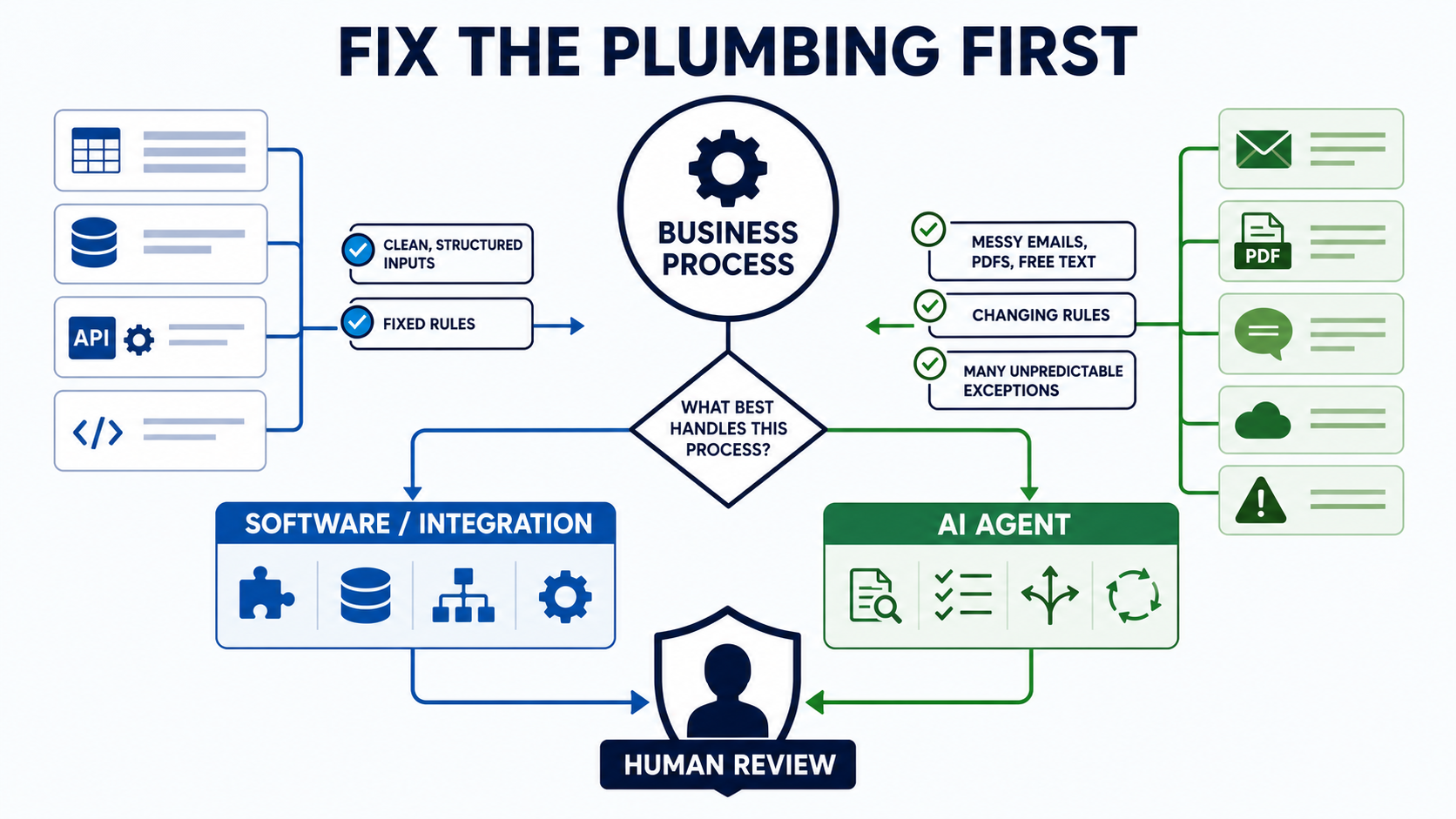
Six questions to ask before choosing AI
1. Can you clearly define the rules?
If you can write the process down on one page and give it to a new employee to follow, you probably do not need an agent.
Traditional software is excellent at applying known rules consistently. When every step can be expressed as "if this, then that," code is likely the more dependable choice.
2. What does the input look like?
Clean database fields, numbers, IDs, and other structured data are ideal for traditional software. The format is known, the meaning of each value is clear, and the result can be validated precisely.
AI becomes more interesting when the inputs are emails, PDFs, contracts, free text, scanned forms, or documents that arrive in dozens of different formats. These inputs require interpretation before a system can act on them.
A hybrid design is often strongest. AI can turn messy information into a defined structure. Deterministic software can then validate the result and complete the transaction.
3. How many exceptions are there?
If a process has five known edge cases, code them.
If it has hundreds of exceptions, new variations appear constantly, and the right response depends on context, an agent may make more sense. Even then, the agent should have a clear scope and explicit rules for escalation.
4. What happens when it is wrong?
This is one of the most important questions.
If an incorrect result is inexpensive, reversible, and easy to identify, an agent may be allowed to act with monitoring. If a mistake can lose money, damage a customer relationship, create a compliance issue, or affect safety, the agent should not make the final decision by itself.
Put a human in the loop, use deterministic validation, or require both.
AI confidence does not mean AI accuracy. A confident-sounding answer is not evidence that the answer is correct.
5. How often does the process change?
If the rules have not changed in five years, write the code.
If policies, document formats, and operating procedures change constantly, AI may provide useful flexibility. That flexibility still needs boundaries, versioned instructions, evaluation, and monitoring.
6. Can you measure whether the agent is doing a good job?
Traditional software can usually be tested with exact expectations: provide this input and expect that output.
Agents require a broader evaluation strategy. Teams need representative test cases, quality criteria, failure categories, and ongoing reviews of production output. Cost, latency, escalation rate, and task completion can matter alongside accuracy.
If you cannot determine whether an answer was good or bad, you do not know whether the agent works. You are only hoping that it does.
The best answer may be a hybrid
This is not always a choice between AI and traditional software.
A reliable workflow might use an AI model to read an unusual purchase order, code to validate the extracted values, an API to retrieve the system-of-record data, and a person to approve a high-value exception.
Each component handles the part of the process that suits it best:
- Integration moves information reliably between systems.
- Traditional software applies clear rules and performs predictable actions.
- AI interprets ambiguous or unstructured information.
- People provide judgment and accountability when the stakes require it.
The architecture should follow the work, not the trend.
Start with the problem
Notice that almost none of these questions are really about AI.
They are about inputs, rules, exceptions, risk, change, and measurement. They are about understanding how the business actually operates.
"We need an AI agent" should never be the starting point.
Sometimes you do not need intelligence. You just need two systems to talk to each other.
Fix the plumbing first. Then let us talk about agents.
Explore BNMA's AI services or talk with us about your workflow.
