
When an AI agent works in the demo but struggles with real work, the first instinct is usually to rewrite the prompt.
Add more instructions. Include more examples. Explain the edge cases. Tell it to double-check its work.
Sometimes that helps. But when one agent is responsible for understanding the request, retrieving data, checking records, formatting the result, and taking action, the problem may not be the prompt.
It may be the structure.
Think about how you would staff the job
Imagine asking one person to handle an entire purchasing workflow.
They read incoming requests, identify documents, extract purchase order details, check those details against the ERP, prepare the output, and send the follow-up email. They also decide what to do when information is missing or two records disagree.
One experienced person might manage all of that at low volume. But as the work grows, you would probably separate the responsibilities.
Someone owns the overall goal and handles exceptions. Others handle specific parts of the process, with clear expectations about what they receive and what they return.
That is a useful way to think about agent architecture, too.
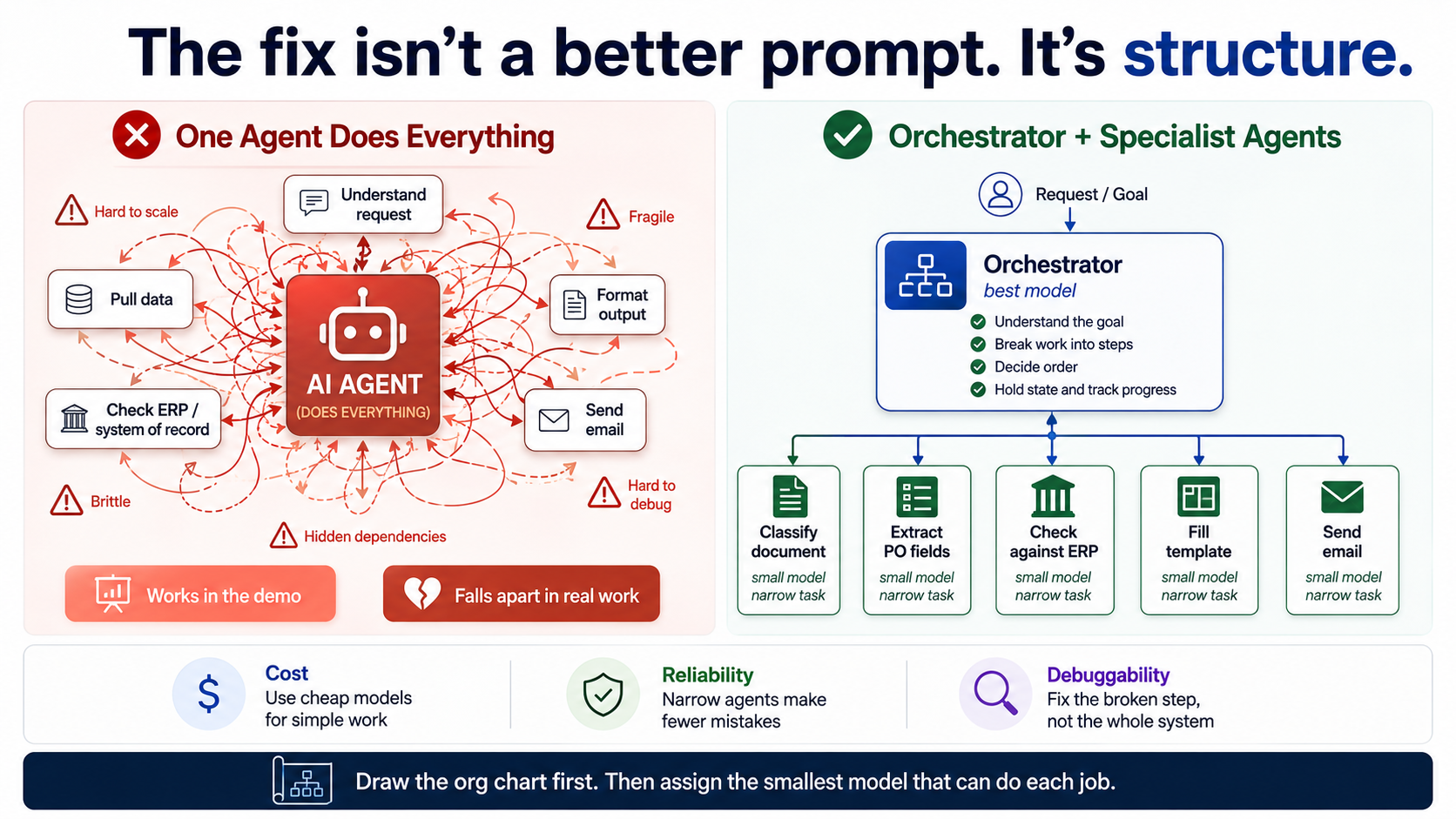
One orchestrator. Focused specialists.
The orchestrator owns the overall request.
Its job is to understand what the user actually needs, break the work into steps, decide which steps depend on others, and track progress. When something unexpected happens, it decides whether to retry, ask for clarification, or escalate to a person.
This is where a more capable model can earn its cost: interpreting ambiguity and making decisions across the workflow.
Underneath it, specialists handle narrower tasks:
- Classify the incoming document.
- Extract the required purchase order fields.
- Retrieve the corresponding ERP record.
- Compare the relevant values.
- Populate an approved template.
- Prepare an email for review or authorized delivery.
Each specialist receives the information it needs and returns a defined result. It does not need the full conversation history, every available tool, or responsibility for the entire process.
The goal is not to create as many agents as possible. It is to give each component a clear job.
Match the model to the work
Not every step needs your most capable model.
Classifying a familiar document or extracting a handful of fields may be well within the abilities of a smaller model. The right choice depends on testing against your actual documents, including incomplete, ambiguous, and unusual examples.
Some steps do not need a model at all.
Looking up an ERP record, comparing exact values, filling a fixed template, and sending an approved email can often be handled with ordinary code and APIs. Use models where interpretation is required. Use deterministic operations where the rules are already known.
That distinction matters. A well-structured agent system is not necessarily a collection of agents talking to other agents. It is a workflow that puts judgment, execution, and validation in the right places.
What this structure buys you
1. More control over cost
If every step runs through an expensive model with a growing context window, you are paying for high-level reasoning even when the task is routine.
Separating responsibilities lets you reserve that reasoning for the decisions that need it. Smaller models can handle suitable high-volume tasks, while code handles predictable operations.
There is a tradeoff: delegation adds calls and coordination overhead. Splitting a simple task into five agents can cost more than doing it once. Measure the cost of the completed workflow, including retries, rather than assuming more specialists automatically means lower cost.
2. Clearer reliability boundaries
A focused component is easier to constrain and test.
An extraction specialist can return a fixed schema and flag missing fields. A validation step can reject an invalid purchase order number. An ERP lookup can explicitly return "record not found" instead of leaving the next step to guess.
Those boundaries make errors easier to catch before they travel downstream.
Specialization alone does not guarantee reliability. You still need input validation, defined failure behavior, and appropriate permissions. Consequential actions, such as updating a business record or sending an external message, should have explicit authorization rules.
The benefit of structure is that those controls have clear places to live.
3. Easier debugging
When one agent handles the entire workflow and produces the wrong result, the cause can be difficult to isolate.
Did it misunderstand the request? Extract the wrong amount? Retrieve the wrong record? Ignore a mismatch? Format the answer incorrectly?
With distinct steps and recorded inputs and outputs, you can trace the failure.
If the extraction is wrong, fix and test extraction. If the lookup returns the wrong record, investigate the lookup. If the final template is incorrect, inspect the formatting step.
You can improve one part without rewriting the instructions for everything else.
Draw the responsibilities before you write the prompts
Before building the agent, map the work.
What requires judgment? What follows fixed rules? Which steps can run independently? What must be verified before the system takes action? When should a person get involved?
For each step, define its input, expected output, available tools, and failure behavior. Keep workflow state explicit so progress does not depend entirely on what a model remembers from a conversation.
Then choose the simplest implementation that meets the requirement: code, a small model, or a more capable reasoning model.
Start with the smallest useful separation. Add specialists when they create a measurable benefit, not because a more elaborate architecture looks impressive.
Structure is the starting point
Better prompts still matter. But a prompt cannot substitute for clear responsibilities, controlled access, and well-defined handoffs.
The instinct is to build one agent that does it all. The better starting point is to draw the org chart, identify where judgment belongs, and assign the smallest model or simplest tool that can reliably do each job.
Small pieces with clear responsibilities are easier to test, understand, and improve.
That is how you move beyond a convincing demo and build a system worth keeping.
Explore BNMA's AI services or talk with us about your workflow.
